11 November 2026 · 11 min
Car watch for used-car dealers 2026: find cars to buy and check them before you pay
A car watch for a used-car dealer should do more than Blocket’s saved search. It should sort out the ads that are not cars for sale at that price, such as monthly prices, wanted ads and parts cars, compare the price with similar cars of the same generation and engine, and leave a ready message to the seller with you, which you read and send yourself. Before payment come the checks no watch does for you: credit purchases and leasing, inspection and tax, the odometer reading and the change of ownership. And Blocket may only be monitored automatically with Blocket’s written permission. Here is how I built such a system for a car dealer in Skåne, what I learned when I measured the ads, and what to check before every purchase.
Why "cheapest first" fools you
When I built the watch I started with the simplest thing: fetch the ads for a model and sort by price. The result was unusable. In six of ten lists I measured, "cheapest first" was topped by ads that were not cars for sale at that price, mainly monthly prices for leasing or instalments and ads from someone who wants to buy a car. Add parts cars and cars with damage in the text, and you see why someone at the firm sits scrolling by hand. A watch for a dealer has to start by clearing that out, before you see anything at all.
The second thing I learned is that a price comparison without generation and engine produces false finds. A model can carry the same name for ten years and still be two different cars. When I compared a V60 with every V60 on the market it looked far below. When the comparison only included the same generation, which can be read from the chassis number, the gap more than halved. That is the difference between a find and a car that is cheap for a reason.
What a watch for dealers should do
- One watch per buying profile. Make, model, model years, maximum mileage, towns and the most you want to pay. Only cars under your own ceiling count as finds.
- The junk gone before you see it. Monthly prices and leasing, wanted and swap ads, sold cars, parts cars and ads with damage in the text are sorted out, and your own ads never show up as finds.
- Price drops that become new finds. When the price of a car is lowered it shows on the card, and when the car drops under your ceiling it appears as a new find.
- Comparison only when the data is enough. In the system I built, the price is compared only when there are at least six similar ads: same model and generation, engine, fuel, gearbox, nearby model year and mileage. With fewer than that the comparison says nothing.
- The AI reads the ad when you ask. One tap gives a short verdict, pros, risks that are not in the headline and questions to ask the seller. It is support before the call, not an inspection.
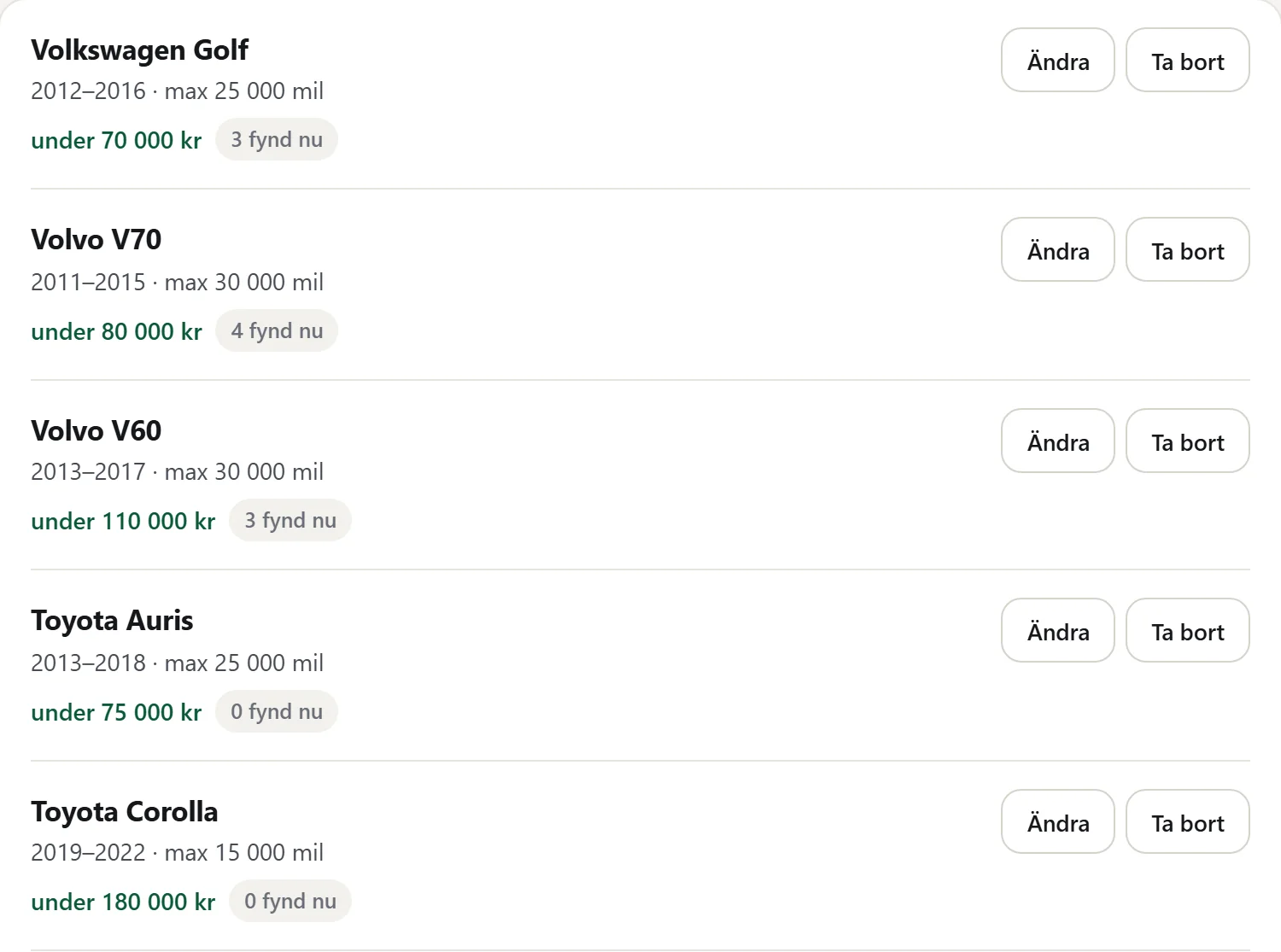
Blocket’s own watch sends a notification when there are new hits on a saved search, and it costs nothing. To see that a car has been listed it is plenty. What it does not do is what takes time afterwards: clearing out the junk, comparing the price with the right cars and writing to the seller. That is why the system accepts an ad you share from Blocket or Bytbil with one tap, and does the rest on it.
First contact: the draft is yours, and you send it
The seller’s email address almost never shows. Contact goes through the ad’s chat, on Blocket as on Facebook, and in a sample I took of 25 private ads, a phone number appeared in the ad text in two of them. So for every find there is a draft in your name, short or with an offer, and a call script when the number is there. One tap copies the text and opens the ad, and you paste and send in the ad’s own chat. Then you mark the car as contacted, so two people at the firm do not write to the same seller.
I never build automatic messages to sellers, for two reasons. The first is that the firm’s account on Blocket also carries your own ads. An account that sends identical messages to many sellers risks being closed, and your ads disappear with it. The second is that the first contact sets the tone of the deal. A message that sounds like a mass mailing gets worse replies than one that sounds like you. Blocket’s terms also forbid using the message service for spam or unauthorised marketing, and the Swedish Marketing Act applies when a business wants to buy, not only when it wants to sell. It is the same principle as in the guide on AI agents for Swedish businesses: what is written in the firm’s name passes a human first.
The customer order: the car has a buyer before you buy it in
A customer wants a particular car at a particular price. You promise to get back to them and write it down, and then the week fills up with other things. In the system you instead send a personal link to a wish form. The customer fills in what they are looking for, and the wish becomes a watch. When a matching car appears, the customer’s first name is on the find, so you can secure it for them. Emails to your customers go from your own address once you have read them, and only to customers who have said yes or have already bought from you. Anyone who says no thanks is blocked. The rules for consent and blocking are the same as in the guide on newsletters to customers.
What Blocket, Bytbil and Facebook allow
Blocket may only be monitored automatically with Blocket’s written permission. It is in the user terms and in the terms for vehicle dealers, and it is you as the dealer who applies, since it is your account and your business. Bytbil is owned by the same company and has the same rule. The automatic check is ready in the system I built but is switched off until the permission exists. Until then you share an ad with one tap and get the comparison and the draft anyway. How fetching from Facebook Marketplace works, and what Facebook’s terms mean for it, I go through with every dealer before they decide.
The ads contain personal data, so the watch should store as little as possible for as short a time as possible. In the system I built, the data from the ads is kept for at most 30 days, sellers’ names are not stored, and the watches, the status of each car and the notes belong to the firm. It is written into a data processing agreement between the dealer and me, and the principle is the same as in the guide on GDPR and AI.
The checks before payment that no watch does for you
The watch finds the car and prepares the call. The rest is your responsibility as the buyer, and that is where the expensive mistakes are made. Go through these points before every purchase from a private seller:
- The vehicle data at the Swedish Transport Agency. Search on the registration number in the Fordonsuppgifter service. It shows, among other things, inspection, tax, whether the car is in traffic or deregistered, the odometer reading from the latest inspection and, under Upplysningar, whether the car was bought on credit. The SMS service 71640 replies with the same flags for credit purchase and leasing. It is free and takes a minute.
- Credit purchases and leasing. A car bought on credit can be taken back by the finance company until the debt is paid, and according to the Swedish Transport Agency you then risk paying for the car twice. A credit purchase sold and reported by a business shows in the register, but a bank loan does not. So ask the seller outright, ask for a settlement statement and pay the debt directly to the finance company before the rest goes to the seller. A change of ownership on a leased car is approved only if the leasing company has approved it.
- The odometer reading. Compare the mileage in the ad with the odometer reading from the latest inspection and with the service history. A mileage that does not add up is a reason to walk away.
- The change of ownership. Both the seller and the buyer must report the change of ownership to the Swedish Transport Agency, and the report must arrive within ten days. If the firm has a permit for direct reporting you do it electronically with the control number from the seller’s registration certificate, otherwise on the yellow part of the certificate. Do it when you pay.
- The VAT. A car you buy from a private person can be sold under the margin scheme: VAT is charged only on your margin, and the invoice must state the margin scheme for second-hand goods but show no VAT amount. A car bought from a VAT-registered company with ordinary VAT is sold with ordinary VAT.
- Cash. If the firm pays or receives cash equivalent to 5,000 euro or more, it is covered by the Swedish anti-money-laundering act. The firm must then register with the Swedish Companies Registration Office before doing such business and check who it does business with, and the county administrative board supervises it.
Checklist for a watch that pays off
- One watch per thing you actually buy, with a price ceiling, instead of a broad search on the make.
- The junk sorted out: monthly prices, wanted ads, sold cars, parts cars and your own ads.
- Comparison against the same generation and engine, and only when there are enough similar cars.
- A draft in your name for every find, which you read and send yourself in the ad’s chat.
- A contacted marker, so two people at the firm do not write to the same seller.
- Customer orders as watches, with the customer’s name on the find.
- Blocket’s written permission before anything monitors Blocket automatically.
- The checks before payment: vehicle data, credit purchases and leasing, odometer, change of ownership and VAT.
What I build for car dealers
I built the car watch for a car dealer in Skåne and showed it at a meeting in September with real ads. Everything described here is in that system: the watches, the comparison, the drafts, the customer order and the blocks. What it looks like, with images from the system, is on the page for car dealers (in Swedish). If you run a workshop too, the guide for car repair shops is written for that part of the business. What I build and how it works is under services, and what to ask to see from any supplier, me included, is in the guide on choosing a supplier for your website and AI.
Frequently asked questions
May a car dealer monitor Blocket automatically?
Only with Blocket’s written permission, according to Blocket’s user terms and the terms for vehicle dealers, and it is the dealer who applies. The same rule applies to Bytbil, which is owned by the same company. Without permission you can use Blocket’s own watch with notifications and share one ad at a time into your own system for comparison and drafts.
How do I see whether a used car has retention of title?
Search the registration number in the Swedish Transport Agency’s Fordonsuppgifter service or text it to 71640. A credit purchase sold and reported by a business shows there, as does leasing. A bank loan does not, so ask the seller anyway, ask for a settlement statement and pay the remaining debt directly to the finance company before the rest of the price goes to the seller.
What should a car dealer check before buying a car from a private person?
The vehicle data at the Swedish Transport Agency (inspection, tax, status and odometer reading), whether the car was bought on credit or is leased, that the mileage matches inspections and service history, that the change of ownership is registered when you pay, and how the car is to be taxed for VAT when you sell it on. If you pay cash equivalent to 5,000 euro or more, the anti-money-laundering act also applies.
Can I sell a car I bought from a private person under the margin scheme?
Yes. A used car you bought from a private person, without VAT, can be sold under the margin scheme. VAT is then charged only on the difference between your purchase price and your sale price, and the invoice shows no VAT amount. If you bought the car from a VAT-registered company that charged ordinary VAT, you sell it with ordinary VAT.
Can the AI send messages to the sellers for me?
In the system I build it never does. It writes a draft in your name for every find, and you read, edit and send it yourself in the ad’s chat. The firm’s account on Blocket also carries your own ads, and an account that sends identical messages to many sellers risks being closed. Besides, a message that sounds like you gets better replies.
How do you compare the price of a used car properly?
Against cars of the same model and generation, with the same engine, fuel and gearbox, nearby model year and similar mileage, and only when there are enough such ads. Clear out monthly prices, wanted ads, sold cars and parts cars before you calculate. A comparison against every car with the same model name produces false finds, because a new generation costs more than the previous one.
Do you buy in used cars?
Book a free 30-minute call. Tell me which cars you buy and where, and I will go through how the watch, the comparison and the drafts would work for your firm. If it is not a fit, I will say so straight.
Book a free call →