11 November 2026 · 11 min
Admin for tradespeople 2026: hours from the phone, ROT and records for the accountant
A tradesperson’s evening admin almost always consists of four things: the quotes, the customers who called while you were on the roof, the hours and materials that need to become an invoice, and what ought to get done but does not, such as the review, the reminder and the follow-up. Most of it can be moved into the day. Hours are reported from the phone on the job, the records for the invoice and the accountant are ready when the job is done, and quotes and reminders become drafts you approve. Here is how I built it for Svensk Filterservice in Skåne, and the rules that decide what the records must look like: the ROT deduction in 2026, domestic reverse charge in construction, the staff register and how long everything must be kept.
Where the evenings go
Ask a tradesperson what they do after dinner, and the answer is almost always the same. The quote the customer is waiting for. The calls you could not take. The puzzle of who worked where on Tuesday and what materials were used. And the list of things that ought to get done: ask for a review, chase an invoice, follow up a quote that went quiet. None of it is the trade, but all of it has to be done, and most of it gets done when you are at your most tired.
The most expensive part is not the time but the delay. A quote written in the evening arrives the next day, and by then the customer has often heard from someone else. How quotes can become drafts while you work is in the guide on AI that writes your quotes. This guide is about the rest: the hours, the records and the rules.
Hours from the phone, without an app or a password
At Svensk Filterservice, which services dust collectors and lays sports floors in Skåne, the technicians are out on jobs all day. Stefan Borsos sets up the jobs in a panel: customer, address, dates and what is to be done, and ticks which employees will be on it. Each employee gets their own link, which they save to the home screen. There they see only the jobs they are assigned to, pick the day and the job, enter the hours and a short line on what they did. It takes about twenty seconds, and Stefan sees the hours at once.
Two things made it a link instead of an app. The first is that an app has to be installed, logged into and updated on every phone, and that is exactly the kind of friction that sends the hours onto a scrap of paper instead. The second is what happens when someone leaves or loses their phone. Stefan closes the link with one tap or gives the person a new one, and the history stays for the year-end accounts. Anyone who entered the wrong figure the same day logs again, and the row is updated instead of duplicated.
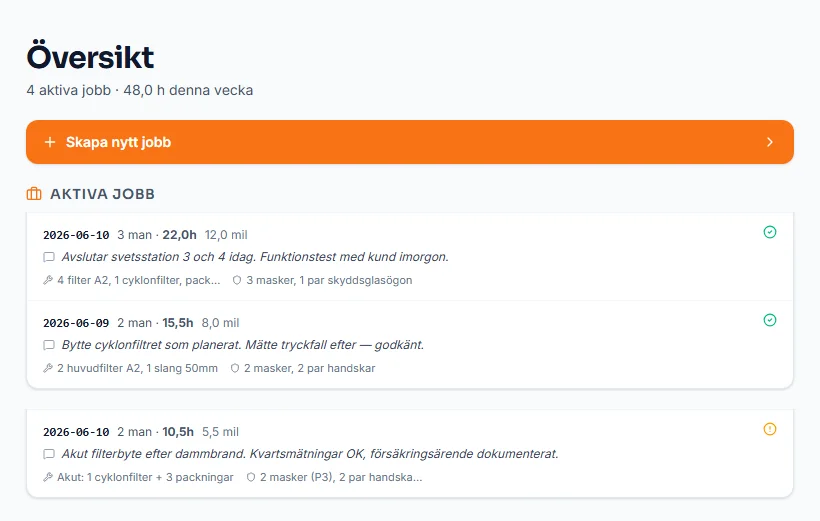
The records are ready when the job is done
When the job is done Stefan moves it to done and then to invoiced, and downloads the records for that job: date, employee, role, customer, address, hours, hourly rate, amount and description, with a total at the bottom. The file opens in Excel and can be imported into the accounting software. That is the whole point. The records for the invoice are not pieced together afterwards; they grew during the job.
Stefan’s own reaction when he saw the panel was: "It’ll save me 8 hours of admin every week." That is his estimate, not my measurement, but it says something about where the time went before.
The rules that decide what the records must look like
The ROT deduction in 2026
According to the Swedish Tax Agency, the ROT deduction is 30 percent of the labour cost from 1 January 2026, after being temporarily 50 percent from 12 May to 31 December 2025. The ceiling is fifty thousand kronor per person per year, and ROT and RUT together at most seventy-five thousand. The deduction covers only the labour, not materials, travel or machinery, so the invoice must separate the labour cost from the rest. The customer pays their part electronically, not in cash, and you claim the rest from the Tax Agency. The claim must arrive no later than 31 January of the year after the customer paid. For cleaning and removal firms the same applies with RUT, and there it is the price after the deduction that decides whether the customer thinks you are expensive.
Domestic reverse charge in construction
If you sell construction services to a company that itself sells construction services, and not just occasionally, for example as a subcontractor, it is the buyer who accounts for the VAT. The invoice must then carry no VAT and instead state that reverse charge applies, along with the buyer’s VAT registration number. To private persons, and to companies that do not themselves sell construction services, you invoice with ordinary VAT. That is why the records per job need to know who the customer is, not just what was done.
The staff register is not your time report
On a construction site where the total cost is expected to exceed four price base amounts, the client must notify the Swedish Tax Agency of the start of construction, and every contractor on site must keep an electronic staff register: who is on site and when they arrive and leave, recorded as it happens. The requirement does not apply when the client is a private person building for themselves. That is something other than a time report. The panel I built for Svensk Filterservice is a basis for the invoice and the accounts, not a staff register, and it should not be presented as one. If the requirement applies to you, you need a system made for the staff register, and the time report then complements it.
How long the records must be kept
Accounting records must be kept until the end of the seventh year after the end of the calendar year in which the financial year ended, under chapter 7, section 2 of the Bookkeeping Act. Since 1 July 2024 you do not have to keep the paper original if you have scanned it in a way where nothing can be changed or lost. That applies to the records per job as much as to the invoice, so a panel with hours must be exportable as a file and stored in a way that lasts seven years, even if you change systems.
The phone, the quotes and what ought to get done
The hours are the part least visible from outside but they eat the most time. The rest of the evening admin is about customers. A customer who calls while you are on a roof calls the next firm, which is why a missed call can be caught with a text message linking to the quote request or with a voice that answers the common questions. A customer who was happy yesterday is the one most likely to leave a review, and the request for a review can go out when the job is marked as done, with at most one reminder. An overdue invoice is not forgotten when the reminder is already waiting as a draft you only need to read and send.
What everything written in your name to an individual customer has in common is that it becomes a draft. You read, edit and press send. What may go out on its own, such as the review request when a job is done, is your decision.
Checklist: the evening admin that can disappear
- Jobs are set up once, with customer, address, dates and who will be on them.
- A personal link per employee, without an app or password, that can be closed or replaced with one tap.
- Hours, mileage and materials per day, reported from the job the same day.
- Records per job as a file, with labour separated from materials and travel for ROT.
- The right VAT per customer: reverse charge to construction firms, ordinary VAT to private persons.
- The staff register on its own, in a system made for it, where the requirement applies.
- Drafts instead of evening writing: quotes, reminders and replies to reviews.
- Seven years in the archive for the records, whatever system you use five years from now.
What I build for tradespeople
The panel for jobs, hours and records has been running at Svensk Filterservice since May 2026, together with the site, the chat and the quote request. The full case is in the guide on Svensk Filterservice, and what it can look like for a trade or service business, with images from the system, is on the page for tradespeople (in Swedish). What I build and how it works is under services. Before you decide, ask to see a system in operation from every supplier you compare.
Frequently asked questions
How can employees report hours without an app?
With a personal link they save to the home screen of their phone. At Svensk Filterservice each employee sees only the jobs they are assigned to, picks the day and the job, enters the hours and a short description, and the owner sees the row at once. If someone leaves, the link is closed with one tap and the history stays for the accounts.
How much is the ROT deduction in 2026?
The ROT deduction is 30 percent of the labour cost from 1 January 2026, according to the Swedish Tax Agency, after the temporary increase to 50 percent that applied from 12 May to 31 December 2025. The ceiling is fifty thousand kronor per person per year, and ROT and RUT together at most seventy-five thousand kronor. The deduction covers only the labour cost, not materials or travel.
When does reverse charge in construction apply?
When you sell construction services to a company that itself sells construction services, for example when you are a subcontractor. The buyer then accounts for the VAT, and your invoice must carry no VAT and instead state reverse charge and the buyer’s VAT registration number. To private persons and to companies that do not build themselves you invoice with ordinary VAT.
Is a time report the same as a staff register?
No. A staff register records who is on the construction site and when they arrive and leave, as it happens, and is required when the client has notified the Swedish Tax Agency of the start of construction. A time report is a basis for the invoice and the payroll. If the staff register requirement applies, you need a system made for it, and the time report becomes a complement.
How long must I keep the records for the accounts?
Until the end of the seventh year after the end of the calendar year in which the financial year ended, under the Bookkeeping Act. Since 1 July 2024 you do not have to keep paper originals if they have been scanned securely. That applies to time reports and per-job records as much as to the invoices, so make sure they can be exported as files from the system you use.
Do I have to change invoicing software to get the hours from the phone?
No. Svensk Filterservice downloads the records per job as a file and takes them on to the invoice and the accountant, and invoicing software you are happy with can stay. What the panel replaces is the scraps of paper and the text messages, not the accounting.
How much of your evening admin could disappear?
Book a free 30-minute call. Tell me what an ordinary week looks like, from enquiry to invoice, and I will tell you straight which parts pay off for you and which do not.
Book a free call →